

Inner Child Work in Relationships: Who’s Really Driving the Car?
April 6, 2026
Inner child work in relationships helps explain reactions that feel bigger than the moment in front of us. Sometimes it shows up as defensiveness. Sometimes it looks like shutting down, overreacting, or feeling unexpectedly hurt by something small.
Most people have had that moment where they think, Why did I respond like that?
In this episode of Therapist Unplugged, Laurie Poole sits down with life and relationship coach Julia Satterlee to talk about how early emotional experiences still shape the way we show up in adult relationships. Their conversation explores emotional triggers, relational patterns, self-trust, and what healing can actually look like in real life.
What Is Inner Child Work?
Inner child work is the process of understanding how early experiences shape the way we think, feel, and relate to other people.
Long before we had language for what was happening around us, we were learning. We were learning what felt safe, what got approval, what caused distance, and what love seemed to require. According to Julia, much of that conditioning happens early, often before the age of seven.
Over time, those early messages can turn into beliefs like:
- I have to earn love.
- I am too much.
- I should stay quiet.
- I am not enough.
Even when those beliefs are never spoken out loud in adulthood, they can still quietly drive how we interpret closeness, conflict, and emotional safety.
Why We Get Triggered in Relationships
One of the clearest signs that inner child work may be needed is emotional reactivity.
A tone of voice can do it. So can a facial expression, a moment of disconnection, or a conversation that suddenly feels much more painful than it should.
Usually, that kind of reaction is not random.
In the episode, Julia explains that triggers are often clues. They point us back to an earlier wound, not because something is wrong with us, but because something unresolved is asking for attention.
In other words, the body may be responding to the present moment while the nervous system is reacting to something much older.
What Inner Child Healing Actually Looks Like
Inner child work is not about blaming your childhood or making every adult problem about the past. It is about understanding the connection between what happened then and what still gets activated now.
Julia describes a process of starting with a current emotional trigger and tracing it back to an earlier experience. From there, the work becomes about identifying what was needed in that moment and learning how to offer some of that care to yourself now.
That might sound simple, but it can be deeply emotional.
For many people, this is the first time they begin to realize they do not have to keep waiting for someone else to finally say the right thing, protect them, or prove their worth.
That is where something important begins to shift.
As Julia says in the episode, “When you know that you can meet your own needs, you are unstoppable.”
Relationships Often Reveal What Is Still Unhealed
One of the strongest themes in this conversation is that relationships tend to bring unresolved pain to the surface.
That is part of why romantic relationships can feel so intense. They often touch the exact places where people feel most vulnerable: rejection, abandonment, criticism, invisibility, or not feeling chosen.
Julia puts it simply: in a relationship, it is rarely just two people in the room. Past experiences, old family dynamics, and earlier emotional injuries often show up too.
Because of that, conflict is not always just about what happened five minutes ago. Sometimes it is also about what happened fifteen or twenty years ago and never got processed.
Why Familiar Patterns Keep Repeating
Without awareness, people often recreate what feels familiar.
That does not necessarily happen because someone wants pain. More often, it happens because the nervous system is drawn to what it already knows.
If love once felt unpredictable, distant, critical, or conditional, those same dynamics can keep resurfacing in adult relationships.
That is why healing is not only about insight. It is also about learning how to respond differently when old patterns start pulling on the wheel.
Once you can recognize what is happening, you have more choice.
And that changes everything.
Coming Back to Yourself
At its core, inner child work is about returning to the parts of you that had to adapt in order to feel safe.
It is about noticing the version of you that learned to shrink, perform, over-function, stay quiet, or keep the peace. It is also about remembering there was always more to you than those survival strategies.
Healing does not mean becoming someone new.
More often, it means coming back to who you were before fear, conditioning, and self-protection took over.
That is the deeper invitation in this episode.
Not to become a different person.
But to become more fully yourself.
Listen to the Full Episode
Listen to the full episode of Therapist Unplugged to hear Laurie Poole and Julia Satterlee explore inner child work in relationships, emotional triggers, and the deeper patterns that shape how we connect. You’ll also hear why this work can be so powerful in both personal healing and romantic relationships.
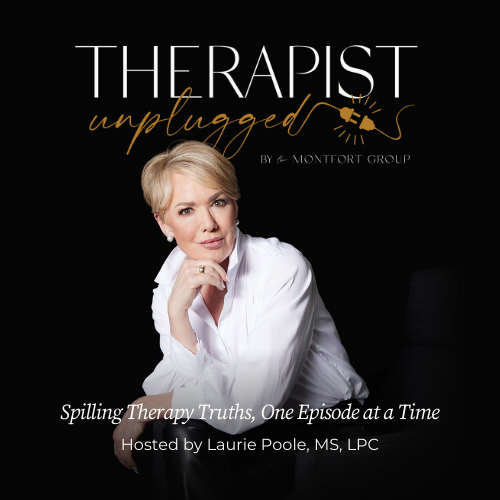
Hosted by Laurie Poole of The Montfort Group, this podcast pulls back the curtain on what really happens in and around the therapy room. No jargon, no perfection—just honest conversations about the messy, meaningful, and deeply human parts of life. We cover everything from burnout and boundaries to sex, shame, relationships, parenting, grief, identity shifts, and mental health in the modern world. Each episode features licensed therapists who get it—because we live it too.